Deutsch

Fast TRIzol®-based RNA extraction with integrity, reproducibility, and less hands-on work
RNA purification often slows down molecular workflows more than it should. Traditional TRIzol® extraction is widely used, but it involves several manual steps that take time and can introduce variability. Phase separation, precipitation, pellet washing, and drying all require careful handling and can affect consistency from sample to sample.
Direct-zol™ from Zymo Research simplifies this process
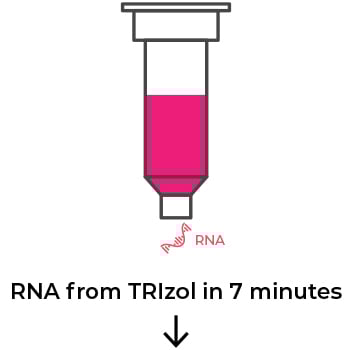
Instead of moving through a multistep extraction workflow, RNA can be purified directly from TRIzol® in a streamlined column-based protocol that takes as little as 7 minutes. The result is a faster workflow that still supports high RNA quality and reliable downstream performance.
Why rethink traditional TRIzol® extraction?
The classic TRIzol® workflow has long been associated with high-quality RNA, but that quality often depends on technique and timing. Even small differences during sample handling can influence recovery and reproducibility.
Typical challenges of traditional extraction include:
- chloroform phase separation
- careful recovery of the aqueous phase
- RNA precipitation and pellet handling
- drying steps that can be inconsistent
- longer hands-on time
- higher operator dependence
In practice, this means that the workflow can become a source of unnecessary variation, especially when multiple samples, different users, or time-sensitive studies are involved.
A simpler alternative: Direct-zol™
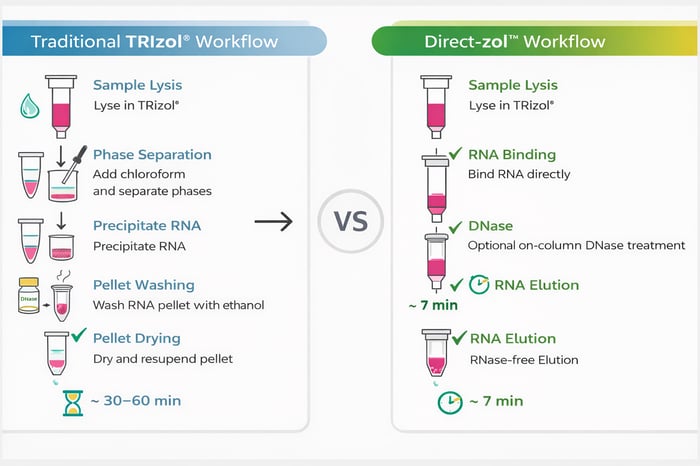
Direct-zol™ was designed to remove the most cumbersome parts of TRIzol®-based RNA purification. RNA binds directly from the TRIzol® sample, eliminating the need for phase separation and precipitation.
Key advantages
- Purify RNA directly from TRIzol®
- No phase separation required
- No precipitation or pellet drying
- Minimal tube transfers
- Optional on-column DNase treatment
- As little as 7 minutes processing time
- High-quality RNA for downstream analysis
Traditional TRIzol® workflow vs. Direct-zol™
| Step | Traditional TRIzol® workflow | Direct-zol™ workflow |
|---|
| Sample lysis | Lyse sample in TRIzol® | Lyse sample in TRIzol® |
| Phase separation | Required | Not required |
| Aqueous phase transfer | Required | Not required |
| RNA precipitation | Required | Not required |
| Pellet washing/drying | Required | Not required |
| DNase treatment | Additional handling | Optional on-column |
| Elution | Resuspend pellet | Elute from column |
| Hands-on time | Often 30–60 minutes | As little as 7 minutes |
Speed does not compromise RNA quality
Fast protocols are sometimes assumed to be less reliable. But workflow duration alone does not determine RNA quality. What matters is how the workflow is designed.
Direct-zol™ combines speed with performance by reducing handling steps that commonly introduce error. RNA purified with Direct-zol™ is suitable for demanding downstream applications and supports reliable analytical performance.
Reported benefits include:
- high RNA integrity
- strong qPCR and RT-qPCR performance
- compatibility with RNA-seq workflows
- recovery of small RNAs, including miRNAs
- reproducible results across users and samples
Conclusion
RNA purification does not need to remain a slow and technique-sensitive bottleneck. By removing phase separation, precipitation, and pellet handling from the process, Direct-zol™ offers a faster and more reproducible way to purify RNA directly from TRIzol®.
The result is a workflow that saves time while maintaining the quality needed for downstream molecular applications.